
Alright, Let Me Tell You About Stollen (and Why My Cat Loves the Smell)
It’s funny: every December, I swear I’ll just buy bread at the bakery like a reasonable person, but then—inevitably—I find myself standing in the kitchen, flour on my nose, making Stollen from scratch. The house smells like a German Christmas market, and, bizarrely, my cat Merlin acts like I’ve summoned him with some kind of festive witchcraft (no, he’s not allowed the raisins, before you worry). There was one year my cousin Tom tried to help and ended up dusted in powdered sugar almost head to toe, so that’s cemented this bread as must-make, if only for the family chaos.
This Is Why You’ll End Up Loving It (Or At Least Laughing At Me)
Honestly, I bake Stollen because my mum always did and my entire family goes bonkers for it. Uncle Rich will actually pretend it’s not his second slice, and for some reason, my youngest nephew likes to fish out the candied peel and line it up on the table (kids are weird).
I make this when I want the kitchen to smell like Christmas or—on nights I need an excuse to eat something with butter and sugar for breakfast. Sometimes, my dough is a sticky mess or the loaf looks a bit lopsided, but once you slice it and spot that marzipan center? Who cares. It’s rustic, not Instagram-perfect (and that’s just fine).
What You’ll Need (And a Few Real-World Swaps)
- 3 1/2 cups all-purpose flour (if I’m out, half bread flour is fine)
- 1/2 cup granulated sugar (Grandma swore by caster sugar; I grab whatever’s handy)
- 2 tsp instant yeast (sometimes I use active dry, but let it foam in the milk first if you do)
- 1/2 tsp salt
- 3/4 cup warm milk (go for whole if you can, but honestly, skim works too in a pinch)
- 1/2 cup unsalted butter, room temp (melt it if you forgot to soften it like I always do)
- 2 large eggs
- 1 tsp vanilla extract (as much as you want, really)
- 1 tsp lemon zest (or orange, because who’s stopping you?)
- 1/3 cup raisins (I bulk it up to 1/2 cup sometimes, or sub currants if it’s what I’ve got)
- 1/3 cup golden raisins
- 1/4 cup chopped candied citrus peel (let’s be real: sometimes I skip it)
- 1/2 cup chopped almonds (or walnuts, or I just use extra raisins if I’m lazy)
- 7 oz marzipan (roll it into a rope, or just plop in chunks—no judgment!)
- Powdered sugar for dusting
For a few ingredients, like the candied peel, I just order from King Arthur Baking if my grocery is out. Or make your own if you’re in a DIY mood (I never have the patience, and that’s the truth).
Here’s How I Actually Make It (With a Few Detours…)
- Soak your dried fruit: In a small bowl, cover raisins and peel with some warm water, rum, or orange juice—whatever you have. Let ‘em sit for at least 30 minutes. Sometimes I forget about them and they sit longer. No disaster yet.
- Get the dough going: In a biggish bowl, whisk flour, sugar, yeast, salt. Pour in the milk, eggs, butter, vanilla, and zest. Mix it up with a spoon (or your hands; it’s messy but fun) till you’ve got a rough dough.
- Knead time: Tip onto a floured counter and knead for 8ish minutes. The dough will be a bit sticky—don’t panic, that’s normal. Add more flour if it’s clinging to you like a needy puppy, but not too much.
- Add the good stuff: Drain your fruit if you haven’t already (I always seem to forget this step). Work fruit and nuts into the dough. Sometimes I do this in stages, sometimes it fights back, but just mash and fold it in. This is my favorite part to taste (just a tiny bit, it’s raw eggs, after all).
- Rest: Pop the dough in a greased bowl, cover with a towel or plastic (use a bag if you can’t find the wrap), and let it rise 1 to 1 1/2 hours or until puffy and doubled.
- Stuff with marzipan: Gently punch down the dough, roll into a rectangle about 1 inch thick-ish. Place the marzipan rope (or, you know, blobs) along the middle. Fold the dough over and, kind of press to seal. It always looks awkward, and that’s fine.
- Second rise: Put on a parchment-lined baking tray, cover again, and rise another 45 minutes. And if you forget and it’s an hour, also fine (sometimes it just gets pillowy, no harm done).
- Bake: Preheat to 350°F (175°C). Bake 35-40 minutes until lovely and golden brown. If it looks too brown, throw some foil on top for the last 10 minutes. Sometimes the bottom browns before the top—just check (lift gently, use a spatula if it’s stubborn).
- Butter and sugar it up: While warm, brush with melted butter and really coat with powdered sugar. Don’t be shy—this is about excess, after all.
- Cool (or sneak a slice): Let it cool a little. My family never waits the full hour. Slicing warm means a raggedy edge, but honestly, who cares?
A Few Notes From Me Trying (and Sometimes Failing) Over the Years
- The dough always feels a little weirdly sticky; just trust. More flour doesn’t always mean moister bread—that’s the lesson.
- I’ve used weird store brand marzipan; didn’t taste much different than the fancy stuff. Save your pennies.
- If I accidentally over-proof it, it just tastes more yeasty (not a dealbreaker).
Variations I’ve Actually Tried (and One Flop)
- Try dried cranberries instead of raisins—actually really good and festive-looking.
- Hazelnuts in place of almonds is not bad at all.
- I once tried chocolate chips and regretted it; they melted and made things odd-textured. Maybe it’s just me.
- Mini stollens: make two or three smaller logs and bake a little less. Great for gifting—or for people who don’t want to share.
What If You Don’t Have a Stand Mixer (Or Even a Rolling Pin)?
You do not have to have a stand mixer. I go old school with a trusty wooden spoon and my (unevenly strong) hands. As for rolling pins, I’ve used a wine bottle a few times—just make sure it’s clean.
Read about baking gear hacks at Smitten Kitchen—makes you feel less bad about your own kitchen chaos.

How to Store Your Stollen (If It Lasts That Long)
Wrap cooled Stollen in foil, then in a plastic bag. Keeps on the counter several days; I think it tastes better the next day (the flavors settle in). It’ll freeze for up to a month. Though, honestly, in my house a loaf rarely makes it past 24 hours unless I actively hide it.
What To Do With It (Besides, You Know, Just Eat It)
In my family, we slice it pretty thick and serve it with coffee for breakfast (sometimes whipped cream accidentally lands on the table—no regrets). Once, I even used leftovers for a kind of bread pudding, which is surprisingly dreamy with a splash of eggnog.
Things I’ve Learned The Hard Way (Don’t Be Me)
- I once tried to skip the first rise because I was starving. Don’t do that—you get a sad, flat loaf.
- Letting it cool before dousing in sugar helps the sugar stick, but, also, eating it warm is its own lovely reward, so… compromise?
- If you’re up for it, toast a slice the next day. Top with salted butter. Trust me, best holiday breakfast (or midnight snack) ever.
Questions People Really Ask Me (Sometimes Twice)
Can I leave out the marzipan? Yep! It won’t technically be super-traditional, but honestly, who’s judging? I do it sometimes when I’ve run out. Still delish.
Is this bread super sweet? Surprisingly, not really! The powdered sugar finish brings most of the sweetness. If you want it sweeter, double the citrus peel or add a teensy bit more sugar (don’t go wild—it doesn’t need cake-level sugar).
Why is my bread dense? Usually comes form under-kneading or adding lots of flour. Actually, I find it works better if you just trust the sticky dough and knead a decent while. Or your yeast was a dud (been there…)
Do I have to use rum to soak the fruit? Not at all; I often use orange juice when I’ve got kids eating, or just warm water. It’s pretty forgiving.
Can I make Stollen ahead? Absolutely. A day or so is perfect—flavors meld; it slices cleaner. If you can wait (I rarely do).
And, hey, if your loaf is wobbly-looking or uneven, just call it “rustic.” No one will complain (they’re all too busy eating).
For more German baking deep-dives (and a solid Stollen history lesson), I sometimes browse German Foods. Always gives me fun facts to bore my family with while the bread bakes.
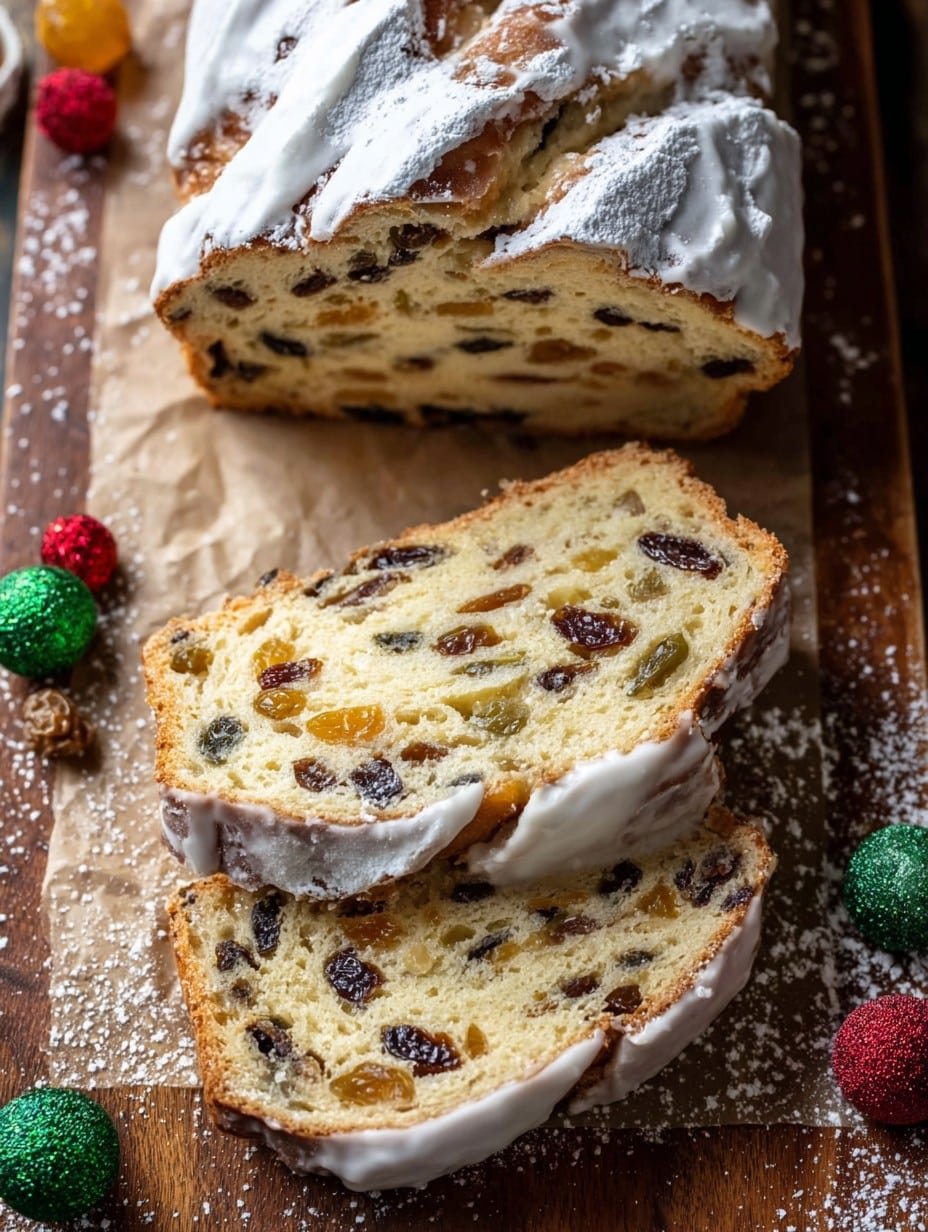
Ingredients
- 3 1/4 cups all-purpose flour
- 1 packet (2 1/4 tsp) active dry yeast
- 1/2 cup warm milk
- 1/2 cup granulated sugar
- 1/2 cup unsalted butter, softened
- 1/2 cup golden raisins
- 1/3 cup chopped dried apricots
- 1/3 cup chopped almonds
- 1 tsp vanilla extract
- 1/2 tsp ground cardamom
- 1/2 tsp salt
- Zest of 1 lemon
- Powdered sugar, for dusting
Instructions
-
1In a small bowl, dissolve yeast in warm milk with 1 tablespoon of sugar. Let it sit for 5-10 minutes until foamy.
-
2In a large bowl, combine flour, sugar, salt, cardamom, and lemon zest. Add the yeast mixture, butter, and vanilla extract. Mix until a dough forms.
-
3Knead in the raisins, apricots, and almonds. Continue kneading on a lightly floured surface for 8-10 minutes until smooth and elastic.
-
4Place the dough in a lightly greased bowl, cover, and let rise in a warm place for 1 hour or until doubled in size.
-
5Shape the dough into a log and fold one side over the other. Place on a parchment-lined baking sheet. Cover and let rise for another 30 minutes.
-
6Bake at 350°F (175°C) for 40-45 minutes or until golden brown. Cool slightly and dust generously with powdered sugar before serving.
Approximate Information for One Serving
Nutrition Disclaimers
Number of total servings shown is approximate. Actual number of servings will depend on your preferred portion sizes.
Nutritional values shown are general guidelines and reflect information for 1 serving using the ingredients listed, not including any optional ingredients. Actual macros may vary slightly depending on specific brands and types of ingredients used.
To determine the weight of one serving, prepare the recipe as instructed. Weigh the finished recipe, then divide the weight of the finished recipe (not including the weight of the container the food is in) by the desired number of servings. Result will be the weight of one serving.
Did you make this recipe?
Please consider Pinning it!!